

Mother Hen God
Second Sunday in Lent: The Gospel


Luke 13:31-35
31 At that very hour some Pharisees came and said to him, “Get away from here, for Herod wants to kill you.” 32 He said to them, “Go and tell that fox for me,[a] ‘Listen, I am casting out demons and performing cures today and tomorrow, and on the third day I finish my work. 33 Yet today, tomorrow, and the next day I must be on my way, because it is impossible for a prophet to be killed outside of Jerusalem.’ 34 Jerusalem, Jerusalem, the city that kills the prophets and stones those who are sent to it! How often have I desired to gather your children together as a hen gathers her brood under her wings, and you were not willing! 35 See, your house is left to you.[b] And I tell you, you will not see me until the time comes when[c] you say, ‘Blessed is the one who comes in the name of the Lord.’ ”

The thing I like about the Revised Common Lectionary is that is forces you to grapple with selections from Scripture that you might otherwise not be reading at that moment, and sometimes – almost providentially – those verses are highly relevant to your life or to the world around us. This week’s Gospel reading is just that; in this political and cultural moment, Luke 13:31-35 seems highly, highly relevant. And, considering my own partiality for Luke 4, or the Sermon on the Mount, or the letters of Paul, it’s likely I wouldn’t have run across it at this moment without the prompting of the RCL.
There are two primary things I want to center out attention around in these four verses right now: hostility to power, and the mothering spirit of God. Let’s take those in order.
The passage begins with Jesus being warned, by a group of Pharisees, that Herod has caught wind of Jesus and his ministry, and is now planning to have him killed. Clearly, the radically egalitarian and love-filled message he’s been preaching has started to discomfort the comfortable, and the powers that be are beginning to make moves to quash any challenge to their authority and privileges.
But, Jesus is unconcerned.
Not only is he unconcerned, he is defiant. “Go and tell that fox for me,” he hisses at the Pharisees; you can practically feel the venom coming off the page. Jesus is not afraid to push back against the powerful, to assert this own authority to speak and preach in the face of oppression and even death. We have here the original Christ-centered warrant to take a stand against the injustice of empire and tyranny. Under the Herodian monarchy that ruled ancient Palestine, the word of Herod was law. If Herod declared the actions and words of Jesus worthy of death, those words carried the full weight of the law behind them, both Palestinian and Roman.
I point this out to make a clear point relevant to the world today: interpretations of Christianity that propose justifications and excuses for the actions of the powerful, that state that the duty of the Christian is not just to be a good disciple, but to be a good citizen, are in direct contradiction to the words and actions of Jesus. Jesus had no interest in submitting to unjust laws and tyranny.
Now, crucially, he did not subsequently endorse violent resistance to empire; the end of Lent brings with it the kind of resistance Jesus lived: that of nonviolent suffering, of laying down one’s life for the sake of disarming and unraveling the illusion of power held so tightly by those in places of authority. But resistance it still was. To refer back to the Philippians selection this week, this is part of the life we are called to imitation of.
Let’s turn to the second point of emphasis here: in his extended response to Herod’s threats, Jesus turns to lament, over the city that Herod exercised his rule from: the city of David, Jerusalem. Despite the threats by the power that resided in that city – clearly meant to dissuade him from moving forward with his planned incursion into the city at Passover – Jesus stands firm, restating his intention to carry out his mission. But, he is clear eyed about this mission: he knows he goes to Jerusalem not as a conquering hero, but like a lamb led to slaughter. Herod’s threats carry so little water with Jesus because that’s the whole point.
And yet, Jesus knows death is a tragedy, and he feels the dread and despair of his impending. So, he offers a lament for the city that, despite his love for its people, will shortly condemn him and call for his death. And, in this lament, we see emerge the mothering character of God’s love for God’s people; “How often have I desired to gather your children together as a hen gathers her brood under her wings.” The love of God, when faced with threats of violence and death, does not back into a defensive crouch. It does not implore us to fight back, to employ principles of just war, to stand your ground and protect your castle.
The love of God, Jesus tells us, is like a mother hen. The love of God is the love of a mother, a feminine love that softens and comforts and grieves.
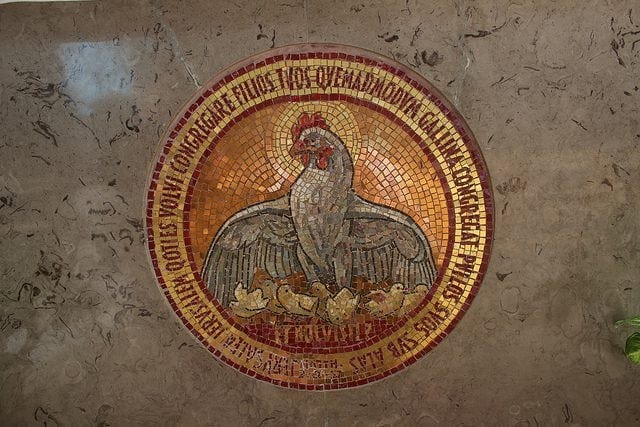

As Gospel verses tend to go, there is a rich ground to pull sermon material from here. In the broadest sense, this selection is a powerful example of Jesus challenging the powers and principalities of the world, in this case King Herod. Despite the threat of tyranny and oppression, Jesus refuses to compromise or qualify his message of compassion and mercy. Referencing back to the Epistle selection this week, this is one of the best places to call people to imitation, in our own willingness to stand up and speak strongly against injustice.
Jesus compares himself to a mother hen in the second half of this selection, and weeps over the people of Jerusalem. This is a highly relevant passage today, in a context where there is a strong push for toxically masculinized Christianity. Jesus here rejects a way of challenging power that involves violence, but instead embraces the mothering love of God for the people.
Psalm 91
1 You who live in the shelter of the Most High,
who abide in the shadow of the Almighty,
2 will say to the Lord, “My refuge and my fortress;
my God, in whom I trust.”
3 For he will deliver you from the snare of the hunter
and from the deadly pestilence;
4 he will cover you with his pinions,
and under his wings you will find refuge;
his faithfulness is a shield and defense.
5 You will not fear the terror of the night
or the arrow that flies by day
6 or the pestilence that stalks in darkness
or the destruction that wastes at noonday.
7 A thousand may fall at your side,
ten thousand at your right hand,
but it will not come near you.
8 You will only look with your eyes
and see the punishment of the wicked.
9 Because you have made the Lord your refuge,
the Most High your dwelling place,
10 no evil shall befall you,
no scourge come near your tent.
11 For he will command his angels concerning you
to guard you in all your ways.
12 On their hands they will bear you up,
so that you will not dash your foot against a stone.
13 You will tread on the lion and the adder;
the young lion and the serpent you will trample under foot.
14 Those who love me, I will deliver;
I will protect those who know my name.
15 When they call to me, I will answer them;
I will be with them in trouble;
I will rescue them and honor them.
16 With long life I will satisfy them
and show them my salvation.

A prayer for the Second Sunday in Lent
Mother God,
like baby chicks, we long to be gathered under your wing, to be brought in to your safety, even when it feels like our enemies are all around us.
Like the Psalmist, we long to declare with great confidence, “The Lord is the strength of my life; of who shall we be afraid?”
But, afraid we are, so often. We look out into this world, and we see the forces of evil and oppression on the move, galloping across our psyches like the four horsemen, bringing to us unrest and weariness, when we do not want it. Fear grips us so often, when we turn on the news, or scroll our feeds, or cue up another podcast.
God, give us the confidence of Paul, who spoke words of such great assurance: our citizenship with you, it is from there we expect you!
Transform us, from these fearful souls.
Hide not your face from us; do not turn us away.
Sustain us, show us the way, wait patiently for us.
In your son’s name, we pray with joy and longing.
Amen.
Reflections
How does the idea of God as mother sit with you?
What connections do you make between the mothering aspect of God, and resistance to tyranny?
Read Psalm 91 again. What words or phrases stand out to you?